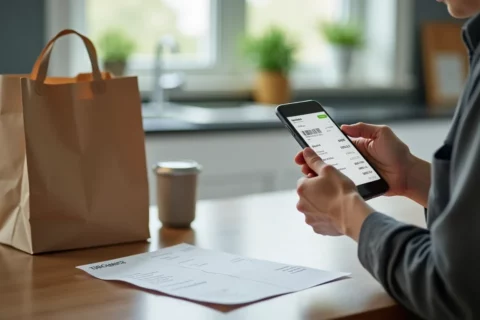

Your friends arrive unannounced on a Saturday afternoon. Someone checks the fridge, finds two warm beers and a bottle of Savanna from last Christmas. Within minutes three people are staring at their phones, thumbs moving fast. Nobody reaches for car keys. Nobody volunteers to brave the Spar queue. The braai starts when the app says 18 minutes, not when someone finally gets back from the shop with the wrong brand anyway.
This is how roughly R109 billion in off-trade liquor now moves through the country. The planned case purchase, the Saturday morning run to Makro for a box of Windhoek and a bottle of Klipdrift, still happens. It shares space with something more restless and more frequent: the six-pack ordered at 4pm on a Sunday, the single bottle of gin added to a grocery run, the emergency mixer when the tonic runs dry mid-conversation. Checkers Sixty60 built its name on groceries, but its liquor numbers show what convenience means when the shelf lives in your pocket.
The New Bottle Store Has No Parking
Physical retail still wins on browsing. You walk into a bottle store, see something new, pick it up, and change your mind. The app strips this down to search and suggestion. Consumers type “craft beer” or “mezcal” or the exact name of what they drank at someone’s house last month, and the algorithm decides what they see first. Brands now buy visibility the way they once paid for end-cap displays, except the end-cap follows you home and knows your order history.
For smaller producers, this cuts both ways. A new Cape Town gin or a KZN brewery can land on the same screen as Diageo and Distell without building distribution into every Tops in every mall. They compete for attention in an interface designed for speed, not discovery. The consumer who once wandered an aisle for ten minutes now decides in ten seconds. The brand not already in their head or at the top of their search barely exists.
The quantity changes too. A case of beer is a commitment: a plan, a boot, a shelf cleared in the garage. The app normalises smaller, more frequent orders. Six beers for tonight. One bottle of wine because someone is coming for dinner. Another six beers on Tuesday because the first six went faster than expected. The total spend drifts upward not through large planned purchases but through friction so low that “six seconds of self-control,” as the phrase goes, is often too much to ask.
The Rules That Still Apply
Convenience has limits, and they are written into law. Delivery cut-off times vary by province and platform, but the pattern holds: weekdays and Saturdays typically stop between 6pm and 8pm, Sundays often earlier. The app that brought your groceries at 8:45pm will not bring your wine. The countdown on screen is licensing, and the countdown is real.
Age verification happens at the door, not in the app. The driver needs your green ID book, your Smart ID, or your driver’s licence. No photograph, no photocopy, no promise that you are definitely over 18. The platform eats the cost of a failed delivery if you cannot produce it, so the driver has reason to be strict. Some services add an in-app age declaration, but the physical check remains the non-negotiable step, the point where digital convenience crashes into regulatory reality.
Delivery fees sit around R35 on major platforms, sometimes with minimum order values attached. Price parity with in-store shelves is the stated goal, but operational costs find their way in. The consumer paying R35 to avoid a twenty-minute drive and a parking search is making a rational choice. However, they are also paying a premium for immediacy that they may not fully register until the monthly card statement arrives.
What Gets Lost in the Countdown
The shift carries quieter costs. Load shedding does not pause because someone ordered beer. Cold chain logistics fail in stages: the fridge at the dark store, the bike or car in traffic, the bag on your doorstep. Inventory accuracy sounds like a backend problem until the app says 12 minutes and the driver calls to say they are out of stock. Now you are negotiating substitutes on a Saturday night with someone who does not drink and cannot spell the brand you wanted.
For consumers, the technology dependence is total. No charged phone, no party. No signal, no service. The person who once kept a case in the garage for emergencies now keeps a power bank. The social ritual of “sending someone to the shop,” the negotiation over who goes and what they bring back, disappears into individual app sessions. Three people at the same braai might place three separate orders from three different platforms, optimising for speed or selection or habit, and the shared errand becomes private consumption.
Retailers gain reach and data, the holy grail of knowing exactly when and what and how often. They lose the in-store impulse, the customer who came for milk and left with a bottle of something new. The digital shelf does not allow for accidental discovery in the same way. Every click is tracked, every search is logged, and the consumer who does not know what they want is guided by what the platform wants to sell.
The Car Keys Stay in the Drawer
The off-trade market at R109 billion is not shrinking. It is restructuring around a different kind of access, one that rewards immediacy over planning and frequency over volume. The bottle store still exists, still serves the person who wants to browse, who buys by the case, who distrusts apps or lives beyond reliable delivery zones. But the growth sits elsewhere: in the order placed at 5pm on a Friday when the week finally breaks, in the extra bottle added to a grocery run without a second thought, in the emergency restock when the ice melts and the conversation is still going.
The charged phone did not replace the car keys entirely. It replaced the moment when you would have reached for them, calculated the time, weighed the effort, and sometimes decided it was not worth it. That moment of hesitation was a form of friction, and friction was a form of choice. With the friction gone, the choice goes too, and the braai starts with an app.