
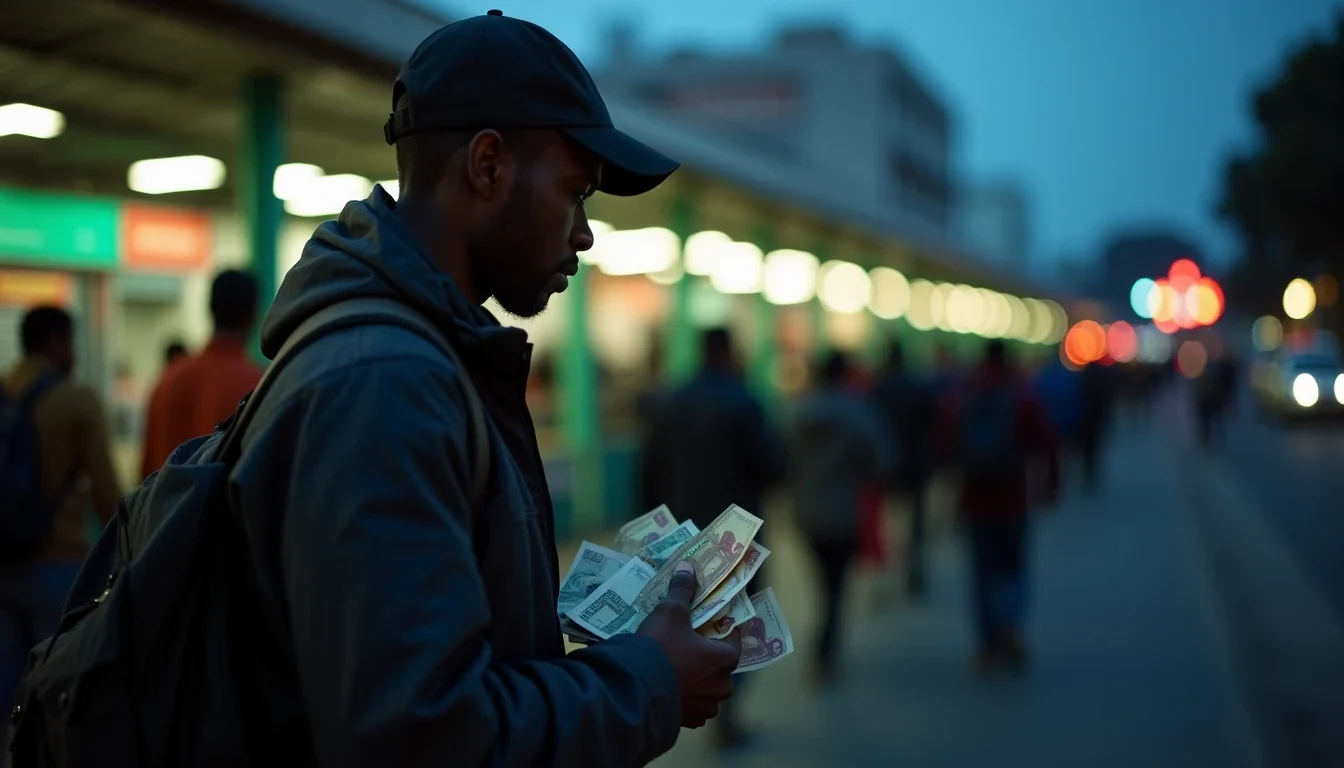
Taxi commuters rent a seat in a system that keeps asking for more. A month with steady shifts and no surprises can already see the fare swallow money people would use for a room, groceries, or prepaid electricity. Once fuel jumps, the bill turns ugly fast.
For workers moving between townships, suburbs, industrial zones, and CBDs, the taxi line item stops looking like transport and starts looking like a second rent payment. A monthly spend of around R1,000 to R1,500 is not a fringe case on busy commuter corridors. It is the difference between a wage that stretches and a wage that gets eaten before the month is halfway done.
Gauteng is where the maths turns brutal
A worker leaving Soweto for Johannesburg CBD or Sandton often deals with more than one taxi and a route that chews time as well as money. A simple return trip can sit around R40 to R70 a day. Over a 22-day work month, that lands roughly between R880 and R1,540 before a single extra detour, late shift, or rank delay.
Diepsloot to Sandton is another clean example of how the fare stack works. A single trip can run at about R25 to R30, and that is only one leg. If the commute requires a feeder taxi first, then a second one to finish the job, the total climbs fast. Alexandra to Centurion or Pretoria CBD can push a worker into the R70 to R90 daily bracket once the connection game starts. Tembisa to Rosebank or Johannesburg CBD follows the same logic, with daily return costs that can sit in the R60 to R80 range.
The real pain is not only the ticket price but also the waiting. Thirty minutes at a rank can become an hour when taxis are full, traffic is bad, or the line is already long before sunrise. Nobody charges for that delay, but the worker still pays for it in missed rest, missed family time, and the kind of fatigue that makes the shift feel longer than it is.
KwaZulu Natal commuters pay twice in time and cash
In Durban, the route from Umlazi to the CBD still runs through the same hard arithmetic. A daily return fare from township to city can sit around R35 to R60, which turns into roughly R770 to R1,320 a month. Umlazi Mega City to Durban CBD may be closer to R20 to R25 one way, but that is only the start if the journey needs another taxi at the far end or a connection back after dark.
KwaMashu workers heading toward Ballito or King Shaka International Airport carry a heavier load. Those northern corridor trips can demand two or three taxis, with daily transport costs that can move past R80 or even R100. The route itself explains the price: you are crossing long distances, passing through multiple ranks, and paying each time the journey changes hands.
Umlazi to Umhlanga Ridge or Pinetown is another route where the fare line refuses to stay simple. The trip often means a local taxi, then a transfer through Durban, then another ride outward. Each handover adds another R15 to R25 or more, depending on how the day is moving. The worker who leaves early and comes home late basically buys a whole chain of transport products to complete one job.
Cape Town’s outer suburbs are paying the city tax
From Khayelitsha to the Cape Town CBD, the fare can land at about R25 to R30 a single trip, but the wider monthly reality is usually R880 to R1,540 once you count five-day commuting, return trips, and the odd increase that gets folded in without much ceremony. Mitchells Plain and Delft sit in the same pressure zone. The distance to the city is not the only issue; the routes also feed into one another, so one worker may pay a local taxi, then a second one to reach a bigger rank, then a final ride to the workplace.
Khayelitsha to Atlantis or Paarl pushes the model even further. Those are long, complicated commutes that can run through Bellville or central Cape Town before the worker even gets close to the final destination. Daily return costs of R80 to R120 are not far-fetched on those routes. Delft or Philippi to Stellenbosch and Somerset West can be just as punishing, especially for workers chasing jobs in the Winelands or Helderberg basin.
The burden stops being a small nuisance and becomes a filter on employment itself. A job that looks acceptable on paper can become absurd once the transport bill is added in.
The hidden charges are doing as much damage as the fare
The advertised taxi price is only the visible part. Waiting for the first ride costs time. Changing taxis costs another fare. Missing the last normal service means paying extra to get home after overtime, if a ride is available at all. Night travel often comes with a premium because there are fewer vehicles on the road and more risk in the system.
A commuter who pays R20 out and R20 back is not necessarily spending R40 a day. Add a feeder taxi, another transfer, and a late return, and the number shifts quickly into R60, R80, or more. Over 22 working days, that becomes a bill that looks a lot closer to housing than transport.
Fuel prices also move through the entire system with very little mercy. Taxi associations do not wait long when petrol or diesel rises. Fares commonly jump by R2 to R5 per trip after a fuel increase, and those small increments accumulate faster than most households can adjust. Four increases of R2 in a year can add R8 to a single ride. Across a monthly commute, that is another R352 gone before anyone has even bought bread.
The wage gets eaten before the month ends
The national minimum wage sits at R27.58 an hour, which works out to about R4,412.80 before deductions for a full-time month of 160 hours. Put a R1,000 taxi bill against that and about 22.6 percent of gross pay disappears. At R1,500, the share climbs to roughly 34 percent. After deductions, the slice gets even uglier.
The rent comparison lands so hard because in many working households, a taxi bill can sit right next to the actual roof over your head. A basic room in a township or informal settlement can cost somewhere between R800 and R2,500. When transport starts competing with housing, the worker is no longer budgeting; they are triaging.
For a two-income household, the pressure multiplies. Two workers paying R1,000 to R1,500 each can burn through R2,000 to R3,000 a month just getting to work. That leaves less room for food, school transport, medical costs, or anything that counts as an emergency until it arrives.
The job has to be worth the trip
The labour market asks whether someone is employed. The pavement asks a sharper question: does the job still make sense once the taxi money is gone? A pay rise can vanish into fare increases. A job further away can be ruled out before an application is even sent. Overtime can become a penalty if the last normal taxi has already left and the return trip costs more than the extra hours earned.
This is the quiet trap sitting inside commuter life right now. The work exists. The shift exists. The wage exists. But on too many routes, the cost of reaching the job is starting to behave like a private tax on being employed.